The Final Chronicle

Can you imagine what the disciples might be feeling right now? It is late Saturday night. Jesus, the teacher, mentor and friend, was crucified yesterday.

What a mixture of emotions! Fear…disappointment…failure? What about anger and loneliness?

These men and women would have thought or even expected Jesus to overthrow the Roman rule and set up His kingdom. They were supposed to be on the winning side!

But now, huddled together, in the shadows, hiding from the authorities, they wait.

Scared and confused.

What would they be waiting for? They probably didn’t know themselves.


Welcome to the Final Chronicle in this Easter series; Chronicles of Calvary.

I have written about some people and even a lamb but tonight’s post will not feature a person. Nor an animal.

It focuses on something different. Something unexpected.

A hill.

A hill called Calvary.

Calvary, also called Golgotha, is located just outside the city of Jerusalem.

Maps - New Testament Bible Maps by Generation Word

This hill, not much more than an outcropping of rock, is the turning point.

On the surface, this hill represents torture, blood, and death. In human eyes, justice is served.

But underneath all of that lies a much different story.

The script is flipped.

Yes, there is still death. Jesus dies. He had to. That was the only way.

Sin is powerful and even victorious – if left unchecked.

But God was never planning on letting it go unchecked.

He had a plan. He always has a plan.

  • Simon was part of God’s plan
  • The Centurion played his part in God’s plan
  • Both criminals were in the plan as well
  • The little lamb that represents the sacrifice for sin is central to the plan

Calvary is part of His plan.


Life is not about you or me.

It is about what God is doing and whether or not we will join Him.

And it all happened on a single hill. God won.

Thank you for taking the time to read this post. I hope it was worth your time.

Mary had a little lamb…

Can you hear the tune in your head?

Mary had a little lamb, little lamb, little lamb…

Cute little guy, isn’t he?

The next character in the Chronicles of Calvary is not about a person. It is a lamb. A one year old lamb without spot or blemish.

We focused on three people for the first three Chronicles. Click on each to read their respective posts.

Simon

Centurion

Two Criminals


There are many aspects to the cross. This post is all about one particular aspect. Sacrifice.

If you have ever tried to read the book of Leviticus in the Old Testament, I am guessing that it was not easy. More so, it could have boring or perhaps really difficult to understand.

The theme of Leviticus is about the sacrificial system that God had set up starting with Moses.

Don’t worry. There will be no Levitical readings here.

Israel, after they escaped Egypt under God’s provisional hand, set about on a journey to the Promised Land.

During that journey, God had given Moses plans and instructions for a tabernacle. This would be a mobile house of worship.

When it was set up, the Levites would be the tribe that would be responsible for the overseeing of all the tabernacle duties; mainly the sacrificing.

Leviticus (named after the tribe of Levi) is the recording of how to do all the tabernacle rituals. Here is one artist’s rendition of the tabernacle.

A Tabernacle for God: Built By The Willing Heart • Spirit Life

But a bigger question that might be looming is one of ‘why’.

Why did God require sacrifice?

Simply stated: Sin was separating God from man. But because God is holy, he could not reside where sin existed. A sacrifice was used to remove the sin from a person or even the whole nation.

It was better to kill one lamb or goat rather than a person. It would not take too long to wipe out Israel if animals were not used as a sacrifice.

For the price of sin to be paid, there must be sacrifice.

Forward into the New Testament. Specifically, John’s gospel.

Here is verse 29 from chapter 1 of John:

“The next day John saw Jesus coming toward him and said, “Look, the Lamb of God, who takes away the sin of the world!” NIV


John knew who Jesus is and what his purpose was.

Jesus was to be the sacrifice for our sin.

Hebrews 9:12 states, “He did not enter by means of the blood of goats and calves; but he entered the Most Holy Place once for all by his own blood, thus obtaining eternal redemption.” NIV

Jesus was the lamb that was slaughtered for our sin and he did it at Calvary.

So I guess that little song was right on.

Mary had a little lamb…

Which are looking for?

Roman crucifixion was common during Jesus’ day. Thousands of people were killed in this way. It was one of the worst ways a person could die. The Romans perfected it.

In fact, the word excruciating literally means ‘out of the cross’. So next time you step on a Lego, you begin to understand how excruciating pain can be.

It seems, though, that only three men were crucified on, what we now call, Good Friday.

Two common criminals. Thieves, malefactors, deserters, traders; really, the worst of the human race. One hanging on each side of Jesus.

Three crosses that stood on a hill | Easter | Pinterest | Tatuagem jesus na  cruz, Tatuagem de santo, Jesus na cruz

An inspection of the words spoken by these two men can reveal many things. Here is Luke’s version:

From Luke 23:

39One of the criminals who hung there hurled insults at him: “Aren’t you the Messiah? Save yourself and us!”

40But the other criminal rebuked him. “Don’t you fear God,” he said, “since you are under the same sentence? 

41We are punished justly, for we are getting what our deeds deserve. But this man has done nothing wrong.”

42Then he said, “Jesus, remember me when you come into your kingdom. d ”

43Jesus answered him, “Truly I tell you, today you will be with me in paradise.”


The first one insulted Jesus. Matthew and Mark both record more of the conversation while John does not have any recorded words about these two rebels. But whatever gospel you read, the words are negative and hurtful. For what ever reason, this criminal was yelling at Jesus.

He was looking for the acceptance of the crowd.

And he was not alone. There were comments made by others. It would easy to imagine a small crowd gathering to watch the events unfold. Hecklers are always present in a crowd.

This first criminal was just one of the crowd. He probably got some nods of agreement with his words. But eternity tells a different story.

Enter the second criminal. This accused man was mark by an attitude far different from the first one.

He looks past Jesus and rebukes the first criminal. He realized that they were doomed. Yes, physically, but even more importantly, spiritually.

He then turns to the Savior and asks to be remembered into the Kingdom of heaven.

Jesus replies, as only a Savior could, that it will happen.

The second malefactor was looking for the acceptance of the Christ.


You and I are hanging on a cross today. We have lived our lives and now we are condemned. But we have a choice.

Regardless of what we have done or where we have done it, we can make the right choice.

Even if we don’t really know or understand all the specifics about faith, we can call on the name of Jesus.

Today can be the day of our salvation.

But it will never happen if we are looking for the acceptance of the crowd.

You can rest assured, however, that it will happen if we are looking for the acceptance of the Christ.

Chronicles, the 2nd

If you recall, the first post in Chronicles of Calvary, is about Simon.

Simon was ordered to carry the cross of Jesus. You can read about him here.

Surveying the Cross” Simon of Cyrene – Daily Encouragement

Let’s move on to the second person in these Chronicles.

The centurion at the cross would have been the soldier in charge of the executions. It was his duty to make sure that all was in order and finally, that the prisoners would perish.

In Mark 15, the centurion at the crucifixion plays a prominent roll. Here are a few verses:

37With a loud cry, Jesus breathed his last.

38The curtain of the temple was torn in two from top to bottom.

39And when the centurion, who stood there in front of Jesus, saw how he died, c he said, “Surely this man was the Son of God!”

40Some women were watching from a distance. Among them were Mary Magdalene, Mary the mother of James the younger and of Joseph, d and Salome. 

41In Galilee these women had followed him and cared for his needs. Many other women who had come up with him to Jerusalem were also there.

42It was Preparation Day (that is, the day before the Sabbath). So as evening approached, 

43Joseph of Arimathea, a prominent member of the Council, who was himself waiting for the kingdom of God, went boldly to Pilate and asked for Jesus’ body. 

44Pilate was surprised to hear that he was already dead. Summoning the centurion, he asked him if Jesus had already died. 

45When he learned from the centurion that it was so, he gave the body to Joseph. 

The Long Good Friday: The Story of Longinus the Centurion | The Inglorius  Padre Steve's World

I bolded (is that the right word?) the verses that reference the centurion.

In 39, he made a proclamation. He was fortunate enough to be present at the most important moment in the history of the world. I think that he knew who that man was, hanging there on the cross.

Verse 45 tells us that he made a pronouncement. Pilate, the Roman ruler, wanted to know for sure, that Jesus had died. The centurion was responsible for that knowledge.

Isn’t it cool that we can learn from the centurion?

We can proclaim that Jesus is God’s son. He was divine and human while he lived on earth. That is information that we can confidently shout from the tallest mountain. Proclaim it today!

We can also pronounce that Jesus died…and is risen! Our faith is for nothing if Jesus never died. Because only in death, can he be risen. And that, is what Easter is all about.

Tomorrow’s post will compare the two thieves that were crucified with Jesus. God bless!

Shadows, the good kind.

Last week, we discussed how shadows can be harmful to our faith. We can be afraid of the shadows in life. But we also know that God is light and the shadows have no power against God. Click here if you want to read last week’s post.


Ponder your shadow for a moment.

Other than our vision, how else do we perceive a shadow?

You can’t touch it. Rather, it touches you. Do you feel it?

It makes no sound and you certainly can’t taste it.

But can a shadow interact with our physical world?

As with most (probably all things) things, we can look to God’s Word for some answers.

Dealing with shadows is no different.

Here are the verses in Acts that originally prompted me to write about shadows in the first place.

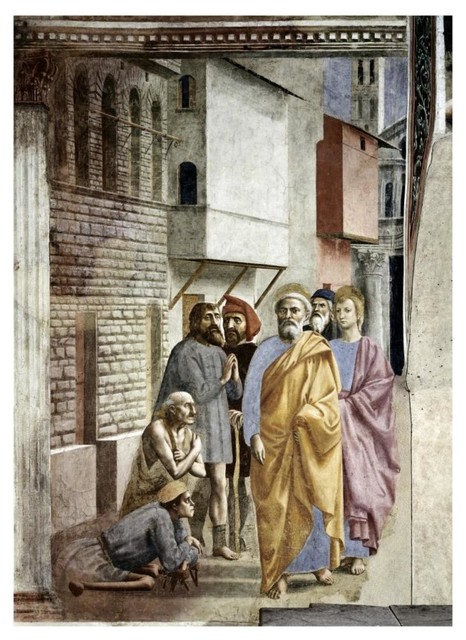
12The apostles performed many signs and wonders among the people. And all the believers used to meet together in Solomon’s Colonnade. 13No one else dared join them, even though they were highly regarded by the people. 14Nevertheless, more and more men and women believed in the Lord and were added to their number. 15As a result, people brought the sick into the streets and laid them on beds and mats so that at least Peter’s shadow might fall on some of them as he passed by. 16Crowds gathered also from the towns around Jerusalem, bringing their sick and those tormented by impure spirits, and all of them were healed.” Acts 5:12-16 NIV

Did you catch v. 15? Apparently, there was power in Peter’s shadow!

I see a process here. If I may, let me break that process into each step.

  1. Verse 14 says that “more and more…believed…” God was doing miraculous work in peoples’ spiritual lives.
  2. Verse 15 states, “As a result…”. Result of what? The salvation that these people were experiencing. The people must have been thinking that God can heal physical issues as well as spiritual issues.
  3. Faith was being bolstered by the numbers of salvations. When people get saved, there is always rejoicing.
  4. Due to this new hardy faith, people were taking physical action. It seems that action will follow a decision.
  5. This action led them to find the disciples, specifically, Peter. Verse 12 explains the interest in find these men.
  6. Faith surpasses proximity. Peter did not even need to touch these people. God’s power finds people of faith.
  7. Physical healings took place. God will sometimes meet spiritual needs before physical needs. Other times, it is reveresed. Either way, it was evident that there was an outpouring of God’s power.
  8. God gets the glory. Regardless of how the healing happens or even if it spiritual or physical, God is the one who is doing the healing. Yes, Peter was involved but God only because God chose to use him in this moment.
St Peter Following St John As He Heals The Sick With Shadow" Paper Art,  34"x46" - Traditional - Prints And Posters - by Global Gallery

While we live through our days, we encounter negative shadows practically every day. But God is so faithful. He can turn bad, fearful, and scary shadows into live-giving shadows.

First of all, look to God. Desire Him, not what He can do.

Once we get that priority straight, God can start to move us through the process I described earlier.

Because God is all-powerful and equally mysterious, He will do what He wants, when He wants to.

Keep close to Him and enjoy the ride!

A life lived for God is never lived in disappointment!